We’ve been talking about Japan for years, and it’s finally happening. It will be our first time in the country, so we’ve planned a loop that takes in the big names – Tokyo, Osaka, Kyoto – and then heads into the mountains for samurai streets, hot springs and snow monkeys, before finishing with a night beside Mt Fuji. Here’s the plan, the places, and why each one made the cut.
Why November?
We’re going in November, and it was a deliberate choice:
- Autumn leaves. Late autumn turns Japan’s maples red and gold. Our week in Kyoto lands right in its peak leaf season, and Lake Kawaguchi holds its autumn leaves festival under Mt Fuji.
- Comfortable weather. Cool, mostly dry days in the cities – perfect for walking – with properly crisp air in the mountains. Typhoon season is over and summer’s humidity is long gone.
- Fuji at its best. The colder, clearer air of late autumn gives some of the best chances all year of seeing the mountain, often with its first snow cap.
- Hot springs weather. There’s nothing better than a steaming outdoor bath on a chilly evening, and in the mountains that’s exactly what we’ll get – the snow monkeys agree.
The route
One loop, no backtracking: we fly into Tokyo, ride the bullet train west to Osaka, move on to Kyoto (with a day trip to Nara), then head north to Kanazawa on the Sea of Japan coast, cross the mountains to the hot-spring village of Shibu Onsen, return to Tokyo, and slip out to Lake Kawaguchi for a night under Mt Fuji before flying home.
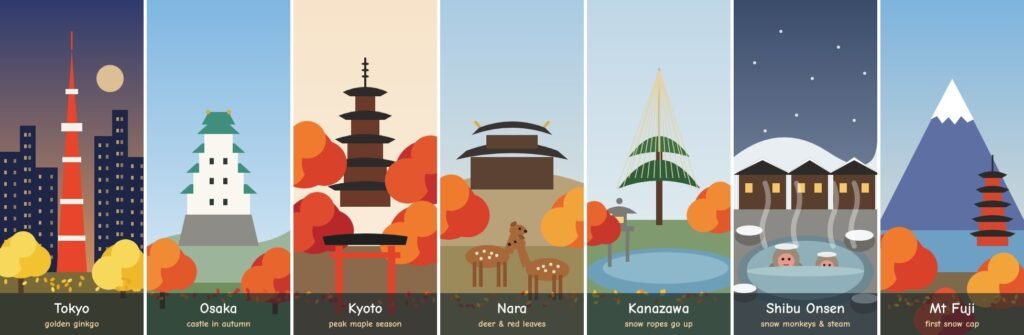
Our big suitcases will travel ahead of us by Japan’s brilliant luggage-forwarding service, so we only carry a small bag on the trains. And because we’re not as young as we used to be, every big day is followed by an easier one, with a rest morning in each city.
Day by day
| Day | Where | Highlights |
|---|---|---|
| 1 | Tokyo | Land in the evening and settle into Shinjuku |
| 2 | Tokyo | An easy first day: our first train rides, Nakano Broadway, ramen and a drink in Golden Gai |
| 3 | Tokyo | Warner Bros. Studio Tour – The Making of Harry Potter, then Pokémon Center Mega Tokyo |
| 4 | Tokyo | Tokyo Disneyland |
| 5 | Tokyo | A slower day: Akihabara, Kanda Myōjin shrine and a café where the staff are robots |
| 6 | Tokyo | Tokyo DisneySea |
| 7 | Tokyo | Meiji Jingu, a capybara café in Harajuku, Shibuya Sky at sunset and yakitori in Omoide Yokocho |
| 8 | Osaka | Bullet train past Mt Fuji, then takoyaki, Dōtonbori’s neon and Osaka-style okonomiyaki |
| 9 | Osaka | Universal Studios Japan and Super Nintendo World |
| 10 | Osaka | Pokémon Café, Kuromon Market, Shitennō-ji and kushikatsu in retro Shinsekai |
| 11 | Osaka | A rest morning, Osaka Castle and the Umeda Sky Building at sunset |
| 12 | Kyoto | Fushimi Inari’s thousands of red torii gates, Tō-ji’s pagoda and lantern-lit Gion at night |
| 13 | Kyoto | Arashiyama’s bamboo forest, a simmered-tofu lunch and the monkeys of Iwatayama |
| 14 | Nara | Day trip: the Great Buddha of Tōdai-ji and the famous bowing deer |
| 15 | Kyoto | The Golden Pavilion, Nijō Castle’s “nightingale” floors and teamLab’s digital art |
| 16 | Kyoto | Kiyomizu-dera, Nishiki Market and a traditional arts show in Gion |
| 17 | Kanazawa | Along Lake Biwa to Kanazawa: seafood at Omichō, samurai streets and the old geisha district |
| 18 | Kanazawa | Kenroku-en garden and the “Ninja Temple” with its hidden passages |
| 19 | Shibu Onsen | Zenkō-ji temple in Nagano, then a traditional ryokan and the village’s nine public baths |
| 20 | Shibu Onsen | The snow monkeys of Jigokudani, more onsen and a local sake tasting |
| 21 | Tokyo | Back over the mountains to the Kirby Café and Tokyo Skytree |
| 22 | Mt Fuji | Chureito Pagoda, hōtō noodles and the autumn leaves lit up at night |
| 23 | Tokyo | Fuji at sunrise, then teamLab Planets and monjayaki in Tsukishima |
| 24 | Tokyo | Sushi breakfast at Tsukiji, the Imperial Palace gardens and Tokyo Tower |
| 25 | Tokyo | A slow last day: wagyu sukiyaki and Sensō-ji in Asakusa |
| 26 | Tokyo | Fly home |
The places, and what makes them special
Tokyo
The world’s biggest city is our first and last stop, and we’ve given it time. Shinjuku is our base: neon, tiny back-alley bars and some of the best ramen anywhere. Harry Potter fans can’t skip the studio tour, built around real sets and props from the films, and we’re doing both Disney parks – DisneySea in particular is unlike any Disney park at home. Between the big days are quieter moments: the forest shrine of Meiji Jingu, the 1,300-year-old Sensō-ji temple in Asakusa, and the view from Shibuya Sky as the city lights come on.
Osaka
Osaka is Japan’s kitchen. Locals call it kuidaore – “eat until you drop” – and we intend to take that seriously. Takoyaki (octopus balls) was invented here, Osaka-style okonomiyaki mixes everything into a savoury pancake, and the crumbed skewers called kushikatsu come from the retro Shinsekai district. Add the neon canal of Dōtonbori, a castle and a day at Universal Studios, and it’s the most fun city on our list.
Kyoto
Kyoto was Japan’s capital for more than a thousand years, and it shows: temples, shrines, wooden townhouses and geisha districts at every turn. We’ll walk through the tunnels of torii gates at Fushimi Inari, the towering bamboo of Arashiyama and the Golden Pavilion of Kinkaku-ji. Kyoto’s food is gentler and more refined – simmered tofu (yudōfu), nishin soba (soba topped with sweet herring) and mochi – and visiting in peak autumn-leaf season should make it unforgettable.
Nara
Just 45 minutes from Kyoto, Nara was Japan’s first permanent capital. It’s home to the giant bronze Buddha of Tōdai-ji, housed in one of the largest wooden buildings in the world, and to more than a thousand free-roaming deer that famously bow for crackers. We’ll also try the pounded green mochi at Nakatanidō, where they make it at high speed in front of the crowd.
Kanazawa
Kanazawa is a quieter treasure on the Sea of Japan coast. It makes almost all of Japan’s gold leaf (yes, we’ll be eating gold-leaf ice cream), has some of the best-preserved samurai and geisha districts in the country, and is home to Kenroku-en, one of Japan’s three great gardens. November is snow-crab season, so the seafood bowls at Omichō Market should be something special.
Shibu Onsen and the snow monkeys
This is the part of the trip we’re most excited about. Shibu Onsen is a small hot-spring village of wooden inns, where guests wander between nine public baths in yukata robes and wooden sandals. Nearby, in the Jigokudani valley, wild Japanese macaques – the famous snow monkeys – soak in a natural hot spring. On the way we’ll stop at Zenkō-ji in Nagano, a temple with a pitch-black tunnel under the main hall, and a bowl of the region’s famous buckwheat soba.
Mt Fuji
We’ll spend one night at Lake Kawaguchi, at the foot of the mountain. The plan is the classic view from Chureito Pagoda, a bowl of hōtō (thick noodles in miso broth), the autumn leaves lit up at night, and – if the weather is kind – Fuji glowing at sunrise across the lake.
What we’re most looking forward to eating
A local dish in every stop:
- Tokyo: yakitori in the alleys under the train tracks, monjayaki in Tsukishima, a sushi breakfast at Tsukiji and wagyu sukiyaki in Asakusa
- Osaka: takoyaki, okonomiyaki, kushikatsu and negiyaki
- Kyoto and Nara: yudōfu, nishin soba, fresh mochi and persimmon-leaf sushi
- Kanazawa: seafood bowls, jibu-ni duck stew and gold-leaf ice cream
- Nagano: Shinshu soba and oyaki dumplings
- Mt Fuji: hōtō noodles
And for the fun of it: a Pokémon Café, a Kirby Café, a Final Fantasy café and a capybara café.
Follow along
There’s still plenty to book – bullet trains, theme-park tickets and a few very popular cafés – and we’ll share how the planning goes, what we learn about travelling in Japan for the first time, and of course the trip itself. If you’ve been and have a tip, we’d love to hear it.

0 Comments